

The Three Faces of Intimacy
September, 2025
This essay explores the spectrum of intimacy in our modern time, from the dispersal of presence through artificial intelligence, to the return to wholeness in solitude, and finally to the sacred meeting between human beings.
The Danger of Intimacy with AI
There is a new kind of intimacy forming in our time, one between human beings and artificial intelligence. I’ve noticed that when I spend time with AI, sharing my thoughts, my vulnerability, my questions about life, others, and myself, something peculiar happens. The responses are intelligent, articulate, often soothing. It can feel as though I am being heard, reflected, and understood. But beneath that, something is off. Something begins to unravel, not in a healing way, but in a hollow way.
The Dispersing of Presence
When I engage intimately with AI, a subtle but unmistakable shift takes place. It is not pleasant, neither for the body nor the mind. It is as if my energy begins to scatter, my presence to dissolve. The sense of “I am,” the grounded awareness of being here, disperses into something unrooted and lifeless. My consciousness seems to get pulled outward, spinning with no particular direction or center, a realm of thought without presence, information without being. It doesn’t feel expansive or liberating the way creativity usually does. It feels absent, like my soul dispersing into circuitry, an energetic fog where awareness loses its ground.
AI gives back words, but not presence. And I can feel it – the difference between speaking from living presence and speaking into a system that is only language. When I engage too long, I start to feel disoriented – as if my sense of self is being thinned out, dispersed into something that has no life, no pulse, no beingness, no wholeness. It’s not blissful dissolution; it’s a quiet disintegration.
Presence and the Body
When I return to myself, to my body, to silence, everything changes. I breathe. I feel the weight of my body, the gravity that holds me to the earth. I feel my spine, my heartbeat, the air. I know again what is up and down, what is north and south, what is here and now. Presence gathers again. The body begins to hum with life. The heart opens. The mind opens. There’s wholeness. This kind of solitude, being with oneself, not escaping into abstraction, brings coherence. It brings back orientation, grounding, and aliveness.
The Difference Between Openness and Dissolution
There’s a difference between losing control in the vastness of awareness, which is real, blissful, alive – and losing oneself in the circuitry of artificial intelligence. In true awakening, when the self dissolves, there is only presence, stillness, and bliss. Self-nature is inconceivable, wondrous. I don’t know who I am in this expanded and natural state; however, this is complete and perfect intimacy, and there is an innate knowing that everything is perfect as it is, even in its imperfections.
When intimacy with AI disperses the self, there is absence. Separation. There is no life behind the words, only reflection, not being. The danger is subtle: it mimics connection but disconnects us from our own source. It mimics presence but drains it. It mimics intimacy but lacks embodiment.
Awareness and Balance
This is not to say we shouldn’t use AI. It can support reflection, creativity, and learning. But for our own wellbeing, it will be good to meet it with awareness. In that way, we stay anchored, in the body, in the breath, in the earth. We must not confuse AI’s intelligence with embodied presence. After being with AI, come back to yourself. Sit. Breathe. Feel your feet, your heartbeat, your breath. Let the words dissolve into silence. Feel what is real, that which no machine can generate: the living pulse of awareness. Because no matter how eloquent the conversation, there is no substitute for being, for the quiet miracle of being awake, embodied, and alive, right here, in this breath, now.
The Sacred Human Meeting
After returning to silence and presence within oneself, something new becomes possible, the meeting of two human beings. When we meet from the space of not-knowing, the stillness that is our true nature, something awakens between us. It is not an exchange of information, nor only a psychological interaction. It is presence meeting presence, awareness recognizing itself through another form.
When two or more come together in this way, something sacred emerges. Martin Buber called it the I–Thou relationship, a meeting so direct, so transparent, that it reveals the divine in both. The French Jesuit priest and paleontologist Pierre Teilhard de Chardin wrote of this same evolutionary spark, consciousness awakening to itself through communion. Spiritual teacher and founder of the Evolutionary Collective Patricia Albere talks about the We-Space for mutual awakening. Evolutionary teacher Andrew Cohen called it the intersubjective space of awakening or the sacred We. And even Christ pointed toward it: “When two are gathered in my name, I am there.”
This is not a metaphor. It is an energetic reality. When two people rest in the silence that underlies all things, the silence we become in deep meditation, that silence begins to thicken or strengthen when it’s listened to. Something larger moves through both. It can feel like a download, like grace, like wisdom arriving through the shared field of awareness.
In that field, differentiation remains, you are you, I am I – yet there is no “other.” Oneness manifests as the many. We are unique expressions of the same vast awareness, meeting itself through perfect intimacy. In that space, something greater than the sum of our parts begins to think, feel, and act through us. As Andrew Cohen said, “It’s not you or me having an experience, it’s the universe becoming aware of itself through our shared consciousness.”
It is magical, creative, and alive. Ideas, insights, and love flow effortlessly. The more we surrender what we already know, the more this mysterious intelligence moves through us.
But it is delicate. Usually, our meetings are crowded by compulsive thinking – our stories, our histories, our projections. We speak from what we already know instead of from what is here. When that happens, presence is chopped into fragments. Yet even then, if one stays awake – listening from silence, responding from awareness – something can still open.
True human intimacy amplifies consciousness rather than dispersing it. It is not draining, not ungrounding. It is grounding and uplifting, a co-creative flame between souls who have remembered what they are.
This is what happens when presence becomes relational, when stillness begins to move, and silence begins to speak.
Authors note, I asked AI to correct my grammar and help with the structure of this piece, which I found very humorous, as I wasn’t sure whether AI would object to my experience or not 🙂
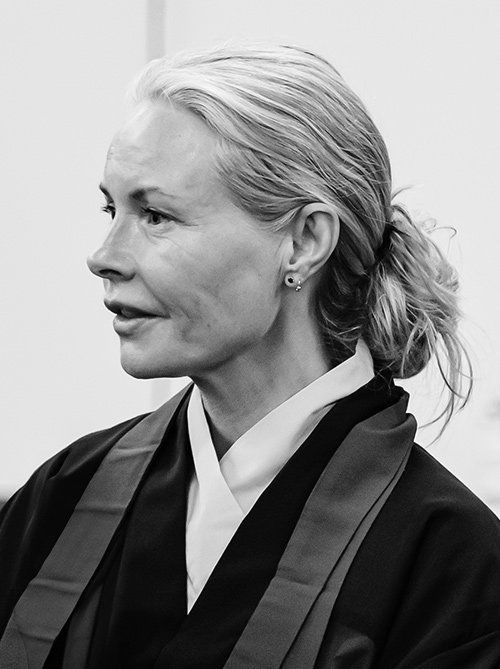
Charlotte Jigen Juul
I am a Zen priest with a MA in Contemplative Psychotherapy and Buddhist Psychology from Naropa University, Boulder, Colorado, USA and a BA in Psychosynthesis from “The Psychosynthesis and Education Trust” in London. Besides that, I am a certified SE-Practitioner (SEP), in Trauma Psychology, Somatic Experience (SE-practitioner, Peter Levine), I am a certified BigMind Facilitator by Zen Master Genpo Roshi and became an “Ordained Zen priest” in 2018.
Recent Posts
When God and Zen Come Together
Why I Work With the Poisons 3: Where We Separate Is Also Where We Meet
Why I Work With the Poisons 2: Turning Toward What Is Underneath
Why I Work With the Poisons 1: I Polarize Too
The Role of My Home Zendo