

Why I Work With the Poisons 2: Turning Toward What Is Underneath
Turning Toward What Is Underneath, part two of three, September 2026
For many years I kept looking at the stories, asking why I felt the way I did. What I needed was to look at the process itself.
The poisons are not obstacles
Awakening and conditioning are not the same thing. Awakening reveals what has always been free. Conditioning is the accumulated patterns through which we perceive, and out of which we project a self, other people, and the world. Awakening does not immediately erase those patterns.
This understanding brought me back to one of the oldest teachings in Buddhism: the poisons.
For a long time I thought of them as obstacles that had to be overcome. Today I see them differently. They are awakened qualities in a contracted state. That makes them the gateway, not something to overlook or get past. They are precisely what we need to recognize, enter, and embrace. And within that, the fear falls away, and they self-liberate.
Contracted, they describe the conditioned movements of the mind and show us how suffering is continually recreated through greed, anger, and ignorance.
In Vajrayana, the three poisons are expanded into five, with pride and jealousy added to greed, anger, and ignorance. Each one can be recognized as the contracted form of a corresponding wisdom quality. Greed is discriminating wisdom, contracted. Anger is clarity, contracted. Ignorance is space, contracted. Pride is equanimity, contracted. And jealousy is enlightened action, contracted.
Underneath the fear
The contraction happens unconsciously, and it becomes habitual without our knowing it. Then it begins to heat up. We identify with our reactions. First: this is mine. Then: this is me. And finally: this is who I am. That is where identity forms. Now pride and jealousy appear, not at the root, but as what protects and maintains that identity. We become invested in being right, being seen, being important, or not being left out.
Most of this happens long before we know it is happening.
When the reactivity is strong, there is usually fear underneath. Not one fear, and not always a big one. Loneliness. The fear of being bored. The fear of losing territory. The fear that I am not the best, not the greatest. Or the opposite, the fear that I will be revealed as the worst, that something is wrong with me. The fear of the unknown.
It comes in layers. Something strong releases, and the subtler ones are still there, waiting.
Beneath that fear there is often a much older contraction, a core wound. A place where, long ago, we concluded that we were not enough, that we did not belong, or that we had to become someone to be worthy.
The poisons become strategies for protecting that core wound, and the fear underneath it. They are how we fight for survival.
If we remain unconscious, one thing gives rise to the next. The feeling tone, pleasant, unpleasant, or neutral, gives rise to craving: wanting more of what is pleasant, less of what is unpleasant, or relief from uncertainty. Craving becomes clinging. Clinging becomes story, identity, and suffering.
We can see dependent origination happening right here.
Being hooked
Being hooked is the sensation of being in the tight grip of wanting things to be different. The mind grabs on: it has to be like this, it cannot be like that. You feel distrustful, angry, impatient, resentful. You have to fix it right now, or cut the connection off completely and never be with this person again.
Or you burn with passion for someone or something. You have to have it. You have to attain it. Nothing else matters until you do.
Usually it is all of it at once. I want this, I hate this, I have to have it, I cannot stand it. One boiling soup. It can be very hot, or it can be very low and heavy. Either way you can feel it. Something has to change. It is unbearable.
Some people need a drink or a smoke to bring themselves down. Some go running, or reach for anything at all that will take the edge off. Others collapse, dissociate, and want nothing to do with anyone.
It is a very painful place to be.
So we lean out of ourselves, trying to fill the vacuum of not knowing, of not feeling certain, of not feeling safe. And we speed up. We want more. More to know, more to get, more to think about, more to analyze.
Anything except to see. Anything except to feel.
The key word is holding on.
Watching the process instead of the story
A little further down the road, I heard myself. I was boiling hot. Oh, this is anger. I know this feeling. At the beach I stood still and let myself become the anger, feeling it move through my body, not pushing it away and not stepping out of it. Then I took a deep breath and let it out into the open sky. I did this a few times, until it began to ease. I laughed. Gosh, how fast the whole world is wrong, just because I feel anger.
When I began to observe the process instead of the story, space opened where there had been tension. The whole thing became much less personal. What had felt so important, my anger, my fear, my jealousy, was revealed as a conditioned process unfolding according to causes and conditions. In seeing that, the attachment to my way, my view, began to dissolve. For a moment there was no one to defend, no one to protect, no one to prove.
There was simply reactivity unfolding.
And with that came space.
In that space, the nervous system gradually discovers that the danger it is reacting to is no longer here. Awareness may already see clearly, yet the body still reacts from old learning. The body remembers. It protects. It prepares for dangers that no longer exist.
Practice is not about getting rid of that. It is about becoming intimate with it.
Again and again, we return to the direct experience rather than the story. This moment is new.
This is why I work with the poisons. Not because I want everybody to study Buddhist philosophy, or to become Buddhists or Zen practitioners. But because this is where we separate.
We all do this. We wish to live, so we protect ourselves, our families, our communities, our countries. And in that protection, we separate. We identify ourselves by saying, “They don’t get it, but we do.” Them and us is a very strong way of organizing our lives into clans and groups.
Families separate here. Couples separate here. Friends separate here. Sanghas separate here. Nations separate here.
In the third and last part: why none of this is wrong, and why the work is far easier done together than alone.
This is the work I do with people, in silence and in conversation. If you would like to sit with it rather than only read about it, Silence by the Sea meets on the first Sunday of each month in Waldport, and I work with people one to one, in person and online.
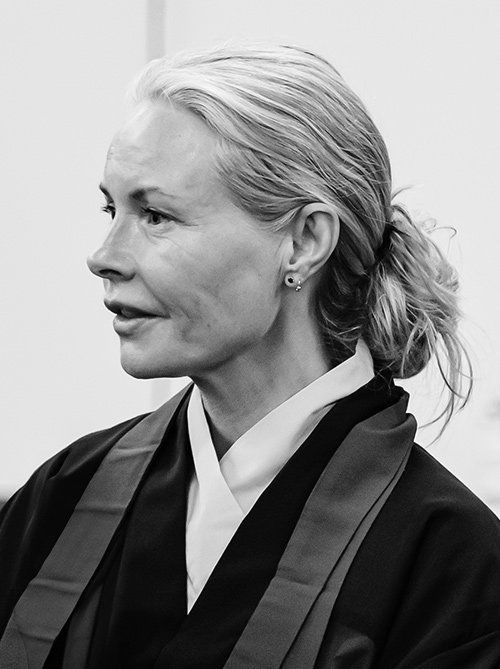
Charlotte Jigen Juul
I am a Zen priest with a MA in Contemplative Psychotherapy and Buddhist Psychology from Naropa University, Boulder, Colorado, USA and a BA in Psychosynthesis from “The Psychosynthesis and Education Trust” in London. Besides that, I am a certified SE-Practitioner (SEP), in Trauma Psychology, Somatic Experience (SE-practitioner, Peter Levine), I am a certified BigMind Facilitator by Zen Master Genpo Roshi and became an “Ordained Zen priest” in 2018.
Recent Posts
When God and Zen Come Together
Why I Work With the Poisons 3: Where We Separate Is Also Where We Meet
Why I Work With the Poisons 2: Turning Toward What Is Underneath
Why I Work With the Poisons 1: I Polarize Too
The Role of My Home Zendo