

Why I Work With the Poisons 1: I Polarize Too
I Polarize Too, part one of three, September 2026
The other day I am crossing Highway 101 in Newport, on my way to the beach, when I get stuck in the middle.
I can’t move. Cars are coming fast in both directions. There is no way forward and no way back, and I don’t know what to do.
A man in the inside lane speeds toward me and slams on his brakes. He leans on his horn—Hooooonk!—and screams out the window, “You bitch! You stupid lady! What are you doing?”
“I know,” I say. “I’m sorry. I’m sorry.”
When I finally make it across, I am shaking. His anger is sitting in my body.
Then, as I drive slowly toward the ocean, it turns.
“What an idiot. Why can’t he just wait? People here don’t know how to drive. They are not city people. They don’t have any patience or room for people like me.”
And it keeps going.
This is not the right place for me. I don’t belong here. I cannot live among people with this mentality. I am too alone here.
In five minutes, I have gone from one angry man to being angry at the whole coast, and from there to being alone in my own life.
By the time I reach the beach, I am not thinking about him at all. I am somewhere else entirely, closed, annoyed, and very much alone.
That is what I mean by polarization. Not the news. Not the country. Me, in my car, closing my heart and calling it: “I am right, and he is wrong.”
Polarization is separation
We say polarization and we picture something out there. Left and right, each side certain the other is the problem. It is in our social life too, and it does not stay out there. It comes into our families and our friendships, into the rooms where we live together.
But before it is any of that, it is something much smaller. One person separating.
I separate from the man. Then from everybody on the coast. Then from the place I live. And last, which is the one that costs the most, I separate from myself. My heart closes. And a closed heart does not always feel like a closed heart. It usually feels like being right and strangely empowered by the anger.
Most of us find this so painful that we stop looking at it. It seems hopeless out there, so we pull in. We keep our own people close and build a place of safety and coherence, and we call that peace. It is not peace, it is a smaller room.
Mostly I believe that if the other person would just stop, or would just agree with me, everything would work perfectly. As long as I believe that, I am waiting for a world that is never going to arrive.
So my practice begins in the only place I have any say. I cannot change him. I cannot change the coast. I can change how I relate to my own experience.
Dogen Zenji says in the Genjōkōan: “To study the Buddha Way is to study the self. To study the self is to forget the self. To forget the self is to be enlightened by the ten thousand dharmas.”
That is not just a teaching. It means the study happens in the car.
Where it actually starts
Something happens. Before I have any opinion about it, it already carries a tone. Pleasant, unpleasant, or neutral. The early teachings call this vedanā, feeling-tone, and everything else turns on it.
The horn was unpleasant. That was not a thought, it was faster than thought. It landed in my chest. I didn’t like it.
We move toward the pleasant. We move away from the unpleasant. What is neutral we mostly do not notice at all, we space out. This happens automatic whether we want it or not. However, we can wake up to it.
This is where the three poisons begin to show themselves: greed, reaching for what I want; anger, pushing away what I don’t want; and ignorance, not seeing what is happening while it happens.
On the highway it was anger, and anger’s work is to attack it, or build a wall, quickly. First around him, then around the coast, then around me. Anger is very efficient. Within a mile I had a complete story with nobody in it but myself.
There is nothing wrong with this. We all do it.
What the story is protecting
Underneath the story it is much simpler. I got frightened. I was standing in the middle of the road, vulnerable and unsure what to do, and instead of another human being recognizing that, what came at me was anger and contempt.
The old word for the pull that follows feeling-tone is taṇhā, thirst. Something in me wants experience to be different from what it is. I want the unpleasant gone. I want something else in its place.
And when that does not happen, I close. The closing feels like strength and protection.
Then I talk to myself about why closing was the correct thing to do. That self-talk is the most convincing voice I know. It rarely says, you were frightened and insecure. It says, these people, this place, this life.
Turning the light around
As long as I am driven by my reactivity without seeing it, I am a leaf in the wind. But when I stop and turn and look at how the reacting actually works in me, space opens, and there is a choice. I can choose not to jog along with the habit, this once.
It looks very small. In the car it would have been noticing my hands on the wheel, noticing the shaking, and letting “I don’t belong here” be a sentence rather than the truth.
I do not know anything about that man. That is the whole point. I never met him. I met my own reaction, and then I lived inside it all the way to the ocean.
In part two I want to look at what happens when we stop running and turn toward what is underneath.
————————
This is the work I do with people, in silence and in conversation. If you would like to sit with it rather than only read about it, Silence by the Sea meets on the first Sunday of each month in Waldport, and I work with people one to one, in person and online.
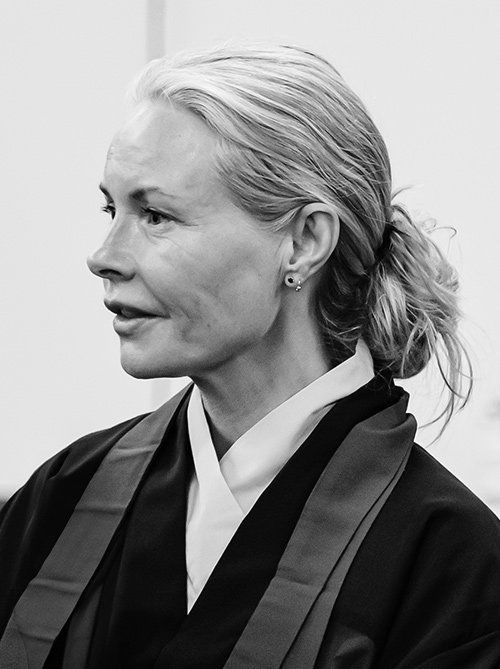
Charlotte Jigen Juul
I am a Zen priest with a MA in Contemplative Psychotherapy and Buddhist Psychology from Naropa University, Boulder, Colorado, USA and a BA in Psychosynthesis from “The Psychosynthesis and Education Trust” in London. Besides that, I am a certified SE-Practitioner (SEP), in Trauma Psychology, Somatic Experience (SE-practitioner, Peter Levine), I am a certified BigMind Facilitator by Zen Master Genpo Roshi and became an “Ordained Zen priest” in 2018.
Recent Posts
When God and Zen Come Together
Why I Work With the Poisons 3: Where We Separate Is Also Where We Meet
Why I Work With the Poisons 2: Turning Toward What Is Underneath
Why I Work With the Poisons 1: I Polarize Too
The Role of My Home Zendo